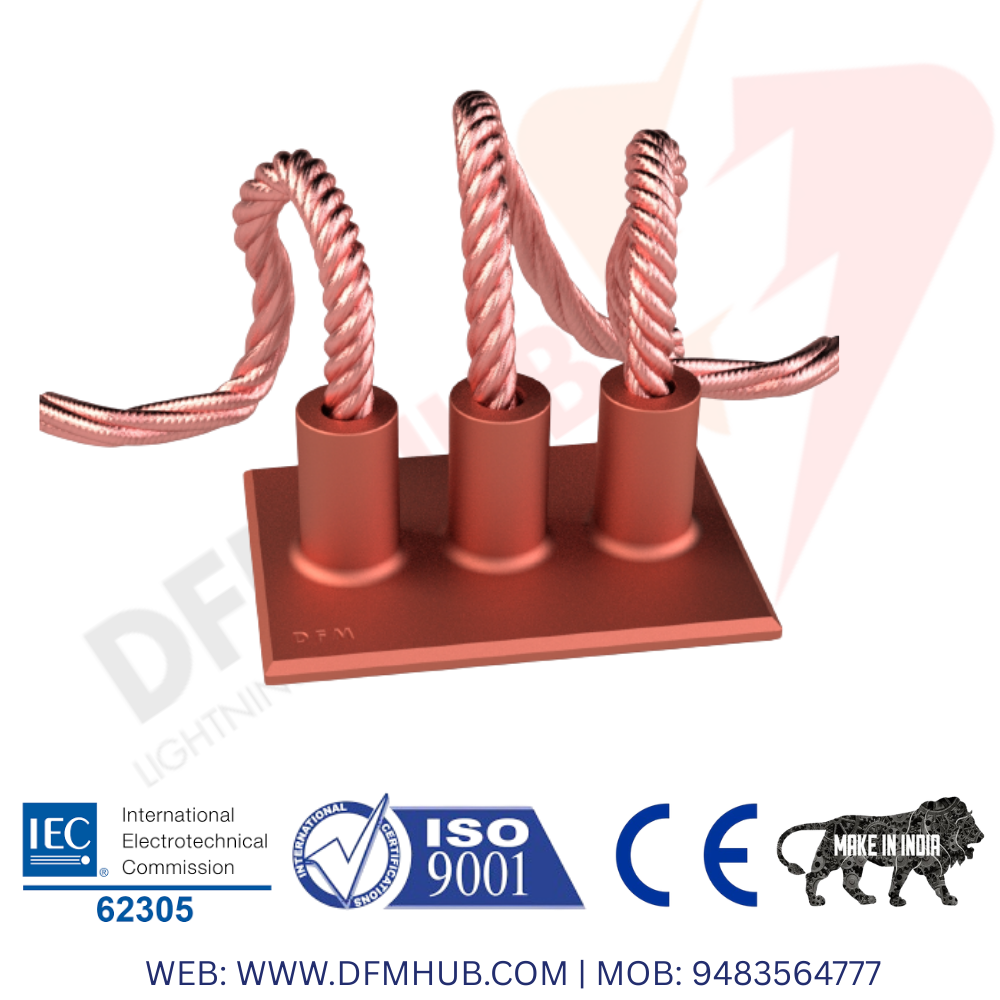
Earth Stud with 3-Way & 5-Way Copper Tail – ARK Make by DFMHUB
The Earth Stud with Copper Tail (CU Tail) by ARK Make – DFMHUB is a critical structural lightning protection component engineered to create low-impedance, multi-directional equipotential bonding between down conductors, structural steel, reinforcement bars, and earthing systems.
Designed and manufactured specifically for Indian climatic, soil, and construction conditions, this earth stud ensures safe dissipation of lightning current from air termination and down conductor networks into the grounding system, in strict alignment with IEC 62305 principles.
What Is an Earth Stud with CU Tail?
An earth stud with copper tail is a permanent electrical bonding point installed on concrete structures, steel members, or RCC columns, allowing multiple lightning conductors to be securely connected and routed toward the earthing system.
3-Way CU Tail: Allows connection of up to three conductors
5-Way CU Tail: Allows connection of up to five conductors
This configuration ensures:
Uniform current distribution
Reduced step and touch potential
Controlled lightning energy dissipation
Why Earth Studs Are Critical in Structural Lightning Protection
Indian Risk Context
India experiences:
High lightning density zones (Odisha, Jharkhand, Bihar, Maharashtra, Kerala, Assam)
Monsoon-driven moisture variation
Mixed soil resistivity (laterite, black cotton soil, rocky strata)
High-rise RCC and steel-hybrid construction
Without proper structural bonding via earth studs, lightning current can:
Flash over through concrete
Damage reinforcement steel
Cause fire, equipment failure, or structural cracking
ARK Make Earth Stud – Engineering Design Philosophy
Design Objectives
Lowest possible contact resistance
High impulse current handling
Mechanical robustness for RCC & steel structures
Long-term corrosion resistanceio in coastal, industrial, and urban environments
Compliance with global lightning protection methodology
Component-Wise Breakdown
| Component | Material | Engineering Purpose |
|---|---|---|
| Stud Body | High-conductivity copper / tinned copper | Primary bonding interface |
| CU Tail (3-Way / 5-Way) | Electrolytic copper strip / braided copper | Multi-directional conductor termination |
| Base Plate | Copper / copper-bonded alloy | Surface contact stability |
| Fixing Hardware | SS / copper alloy | Mechanical integrity |
| Protective Finish | Tin / natural copper | Corrosion resistance |
3-Way vs 5-Way CU Tail – Selection Guide
| Parameter | 3-Way CU Tail | 5-Way CU Tail |
|---|---|---|
| Number of Conductors | Up to 3 | Up to 5 |
| Typical Application | Medium structures | Large / complex structures |
| Down Conductor Density | Moderate | High |
| Current Distribution | Balanced | Highly distributed |
| Use Case | Commercial buildings | Data centers, plants, refineries |
Step-by-Step Engineering Methodology
Step 1: Risk Assessment
Identify lightning risk level (LPL I–IV)
Determine number of down conductors
Step 2: Structural Bonding Design
Define earth stud locations on columns, beams, or steel frames
Select 3-way or 5-way CU tail based on conductor density
Step 3: Installation
Embed or anchor earth stud securely
Connect copper tails to down conductors using approved clamps
Step 4: Earthing Integration
Route conductors to ring earth or earth pits
Ensure continuity and low resistance
Step 5: Testing
Visual inspection
Continuity and resistance measurement
Testing & Performance Validation
| Test | Standard | Result |
|---|---|---|
| Visual & Dimensional | Internal QA | Pass |
| Electrical Continuity | IEC methodology | < 0.1 Ω |
| Mechanical Strength | Site simulation | Pass |
| Corrosion Resistance | Salt spray (coastal simulation) | Pass |
| Impulse Current Capability | Lightning waveform simulation | Verified |
Standards & Compliance Table
| Standard | Relevance |
|---|---|
| IEC 62305-3 | Structural lightning protection |
| IEC 62561 | Lightning protection components |
| IS/IEC adoption | Indian compliance framework |
| NBC India | Building safety integration |
Industry-Wise Applications
Commercial & Residential Buildings
High-rise apartments (Mumbai, Pune, Bengaluru)
IT parks & offices (Hyderabad, Chennai)
Industrial Facilities
Refineries & petrochemical plants
Cement & steel plants
Energy & Infrastructure
Solar PV plants
Wind turbine foundations
Substations & transmission towers
Critical Facilities
Data centers
Airports & metro rail projects
Hospitals & research facilities
Designed & Manufactured for India
Unlike generic imported accessories, ARK Make Earth Studs are:
Sized for Indian conductor practices
Tested for Indian soil and humidity
Compatible with Indian site workmanship realities
Manufacturer vs Trader Comparison
| Aspect | ARK Make (DFMHUB) | Generic Trader |
|---|---|---|
| Design Ownership | ✔ In-house engineering | ✖ No |
| India-specific design | ✔ Yes | ✖ No |
| Standards understanding | ✔ Deep | ✖ Limited |
| Technical support | ✔ Engineering team | ✖ Sales only |
| Customization | ✔ Available | ✖ Not available |
| Traceability | ✔ Batch controlled | ✖ None |
Services & Engineering Support by DFMHUB
Lightning risk assessment support
BOQ & system design assistance
Product customization (tail length, stud size)
Installation guidance & drawings
Post-installation audit support
Frequently Asked Questions (FAQs)
1. What is the role of an earth stud in lightning protection?
It provides a controlled bonding point for multiple conductors to safely dissipate lightning current.
2. When should I choose 5-way instead of 3-way?
For high-rise or complex structures with multiple down conductors.
3. Is this product compliant with IEC 62305?
Yes, it is designed in alignment with IEC 62305 principles.
4. Can it be used in coastal areas?
Yes, corrosion-resistant materials are used.
5. Is it suitable for RCC structures?
Yes, it is specifically engineered for RCC and steel structures.
6. Does DFMHUB provide drawings?
Yes, installation and layout support is available.
7. Can CU tail length be customized?
Yes, project-specific customization is supported.
8. Is it compatible with solar lightning protection systems?
Yes, widely used in rooftop solar PV installations.