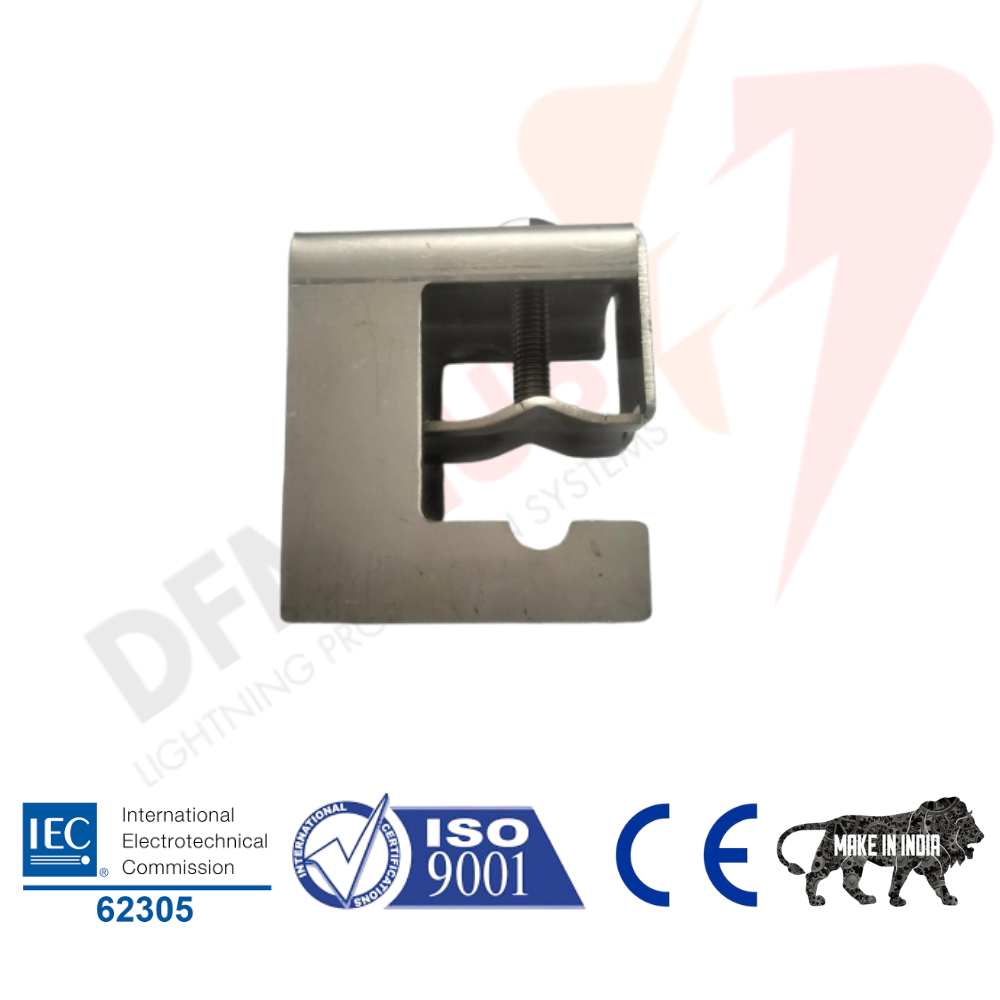
Rebar Bonding Clamp ARK Make by DFMHUB for Structural Lightning Protection Systems
A Rebar Bonding Clamp is a critical electrical and mechanical connector used in structural lightning protection systems (LPS) to ensure equipotential bonding between reinforcement steel (rebars) embedded in concrete and the lightning down conductor or earthing network.
In reinforced concrete (RCC) structures, rebars form a continuous conductive mesh. When correctly bonded, this mesh acts as a natural down conductor and earth electrode, safely dissipating lightning currents into the ground. The Rebar Bonding Clamp ARK Make by DFMHUB is engineered to create a permanent, low-resistance, corrosion-resistant bond that remains electrically stable for the entire life of the structure.
Designed and manufactured by DFMHUB, this clamp is purpose-built for Indian construction practices, soil resistivity variations, monsoon-driven moisture cycles, and long-term durability requirements.
Why Rebar Bonding Is Essential in Structural Lightning Protection
The Engineering Principle
Structural lightning protection relies on three fundamentals:
Interception of lightning
Safe conduction of lightning current
Efficient dissipation into earth
Rebars embedded in concrete offer:
Large conductive cross-section
Multiple parallel current paths
Uniform current distribution
Reduced step and touch potentials
However, these advantages are realized only if rebars are electrically bonded. Poor or inconsistent bonding leads to:
Arcing within concrete
Concrete spalling and cracking
Elevated potential differences
Failure to meet IEC 62305 requirements
The Rebar Bonding Clamp ARK Make ensures mechanically secure and electrically continuous bonding, even under extreme lightning impulse currents.
Primary Keyword Placement (First 100 Words)
The Rebar Bonding Clamp ARK Make by DFMHUB is a specialized connector used in structural lightning protection systems to bond reinforcement steel bars with the earthing and down conductor network. Designed for Indian infrastructure and compliant with IEC 62305, this rebar bonding clamp ensures permanent equipotential bonding in RCC foundations, high-rise buildings, industrial plants, and critical infrastructure across India.
Product Overview: Rebar Bonding Clamp ARK Make
Core Purpose
To create a low-impedance, mechanically robust, corrosion-resistant electrical connection between:
Rebar to rebar
Rebar to copper / aluminium down conductors
Rebar to foundation earth conductors
Typical Installation Locations
RCC foundations
Columns and footings
Raft foundations
Pile caps
Basement slabs
Component-Wise Engineering Breakdown
| Component | Material | Engineering Role |
|---|---|---|
| Clamp Body | High-conductivity copper alloy / GI | Primary current-carrying path |
| Clamping Bolts | Stainless steel / hot-dip galvanized | Maintains constant contact pressure |
| Serrated Contact Surface | Machined profile | Penetrates oxide layers on rebar |
| Locking Mechanism | Anti-loosening design | Prevents relaxation over time |
| Protective Coating | Tin / zinc coating | Corrosion resistance in concrete |
Electrical & Mechanical Performance Characteristics
| Parameter | Performance |
|---|---|
| Lightning Current Capacity | Up to 200 kA (10/350 µs waveform) |
| Contact Resistance | < 1 mΩ |
| Mechanical Holding Strength | Designed for permanent embedment |
| Corrosion Resistance | Suitable for alkaline concrete & moist soil |
| Service Life | Equal to building design life |
Structural Lightning Protection Methodology Using Rebar Bonding Clamp
Step-by-Step Engineering Method
Step 1: Rebar Network Identification
Identify vertical and horizontal rebars forming the structural cage
Ensure continuity across columns and foundations
Step 2: Clamp Selection
Select clamp size based on:
Rebar diameter (8 mm to 32 mm typical in India)
Conductor size (25×3 mm copper strip, 8–10 mm round conductor)
Step 3: Surface Preparation
Remove loose rust, cement slurry, or oil
No aggressive grinding required due to serrated clamp design
Step 4: Mechanical Fixing
Clamp installed with controlled torque
Ensures permanent metal-to-metal contact
Step 5: Integration with Earthing System
Bonded rebar network connected to foundation earth electrodes
Achieves equipotential earthing as per IEC 62305
Design Philosophy: Engineered for Indian Conditions
India-Specific Engineering Considerations
| Indian Condition | Design Response |
|---|---|
| High soil resistivity regions | Larger bonded rebar networks |
| Coastal & saline environments | Corrosion-resistant alloys |
| Monsoon moisture cycles | Stable contact pressure |
| High-rise urban construction | Compact clamp geometry |
| Long design life expectations | Zero-maintenance design |
The Rebar Bonding Clamp ARK Make by DFMHUB is not adapted from imported designs—it is engineered specifically for Indian construction realities.
Standards & Compliance
Applicable International & Indian Standards
| Standard | Description | Compliance |
|---|---|---|
| IEC 62305-3 | Lightning Protection – Physical Damage | ✔ |
| IEC 62561 | Lightning Protection Components (LPC) | ✔ |
| IS/IEC 62305 | Indian adoption of IEC standard | ✔ |
| NBC India | National Building Code | ✔ |
| CPWD Specifications | Government project compliance | ✔ |
Testing & Quality Assurance
Electrical Testing
High impulse current testing (10/350 µs)
Contact resistance measurement
Thermal stability under surge conditions
Mechanical Testing
Tensile pull-out strength
Vibration resistance
Long-term pressure retention
Environmental Testing
Salt spray corrosion testing
Concrete alkalinity exposure
Humidity and temperature cycling
Test reports and compliance certificates are available on request.
👉 CTA: Download Technical Datasheet
Industry-Wise Applications in India
| Industry | Use Case |
|---|---|
| Commercial Buildings | High-rise RCC lightning protection |
| Data Centers | Low-impedance earthing networks |
| Power Plants | Turbine & transformer foundations |
| Oil & Gas | Tank farm RCC structures |
| Railways & Metro | Stations and viaducts |
| Airports | Terminal buildings and towers |
| Solar & Wind | Foundation earthing for towers |
Used extensively in Mumbai, Delhi NCR, Bengaluru, Chennai, Hyderabad, Pune, Ahmedabad, and industrial corridors across India.
Manufacturer vs Trader: Why ARK Make by DFMHUB
| Parameter | DFMHUB (Manufacturer) | Typical Trader |
|---|---|---|
| Design Ownership | In-house engineering | No |
| Material Control | Full traceability | Limited |
| Customization | Project-specific | Standard only |
| Compliance Support | Engineering documentation | Minimal |
| After-Sales Support | Technical team | Sales-only |
| Long-Term Reliability | Proven | Unverified |
Services & Technical Support
DFMHUB provides end-to-end engineering support, including:
Lightning risk assessment (IEC 62305-2)
Structural LPS design
Foundation earthing layouts
Product selection & BOQ optimization
Installation guidance
As-built documentation
👉 CTA: Request Engineering Consultation
Frequently Asked Questions (FAQs)
1. What is the function of a rebar bonding clamp in lightning protection?
It electrically bonds reinforcement steel to form a continuous lightning current path into earth.
2. Is rebar bonding mandatory under IEC 62305?
Yes, equipotential bonding of structural metal is mandatory to prevent dangerous sparking.
3. Can rebars act as natural down conductors?
Yes, when correctly bonded and connected to earth.
4. Is the ARK Make clamp suitable for Indian soil conditions?
Yes, it is designed for high resistivity soils, moisture cycles, and corrosion risks in India.
5. Does it require maintenance after concreting?
No, it is a permanent, maintenance-free connection.
6. Can it connect copper strip to steel rebar?
Yes, it is designed for bimetallic compatibility.
7. Is testing documentation available?
Yes, impulse, corrosion, and mechanical test reports are available.
8. Can it be used in government projects?
Yes, it complies with IEC and NBC requirements used in CPWD and PSU projects.
9. What rebar sizes are supported?
Typically from 8 mm to 32 mm, with custom sizes available.