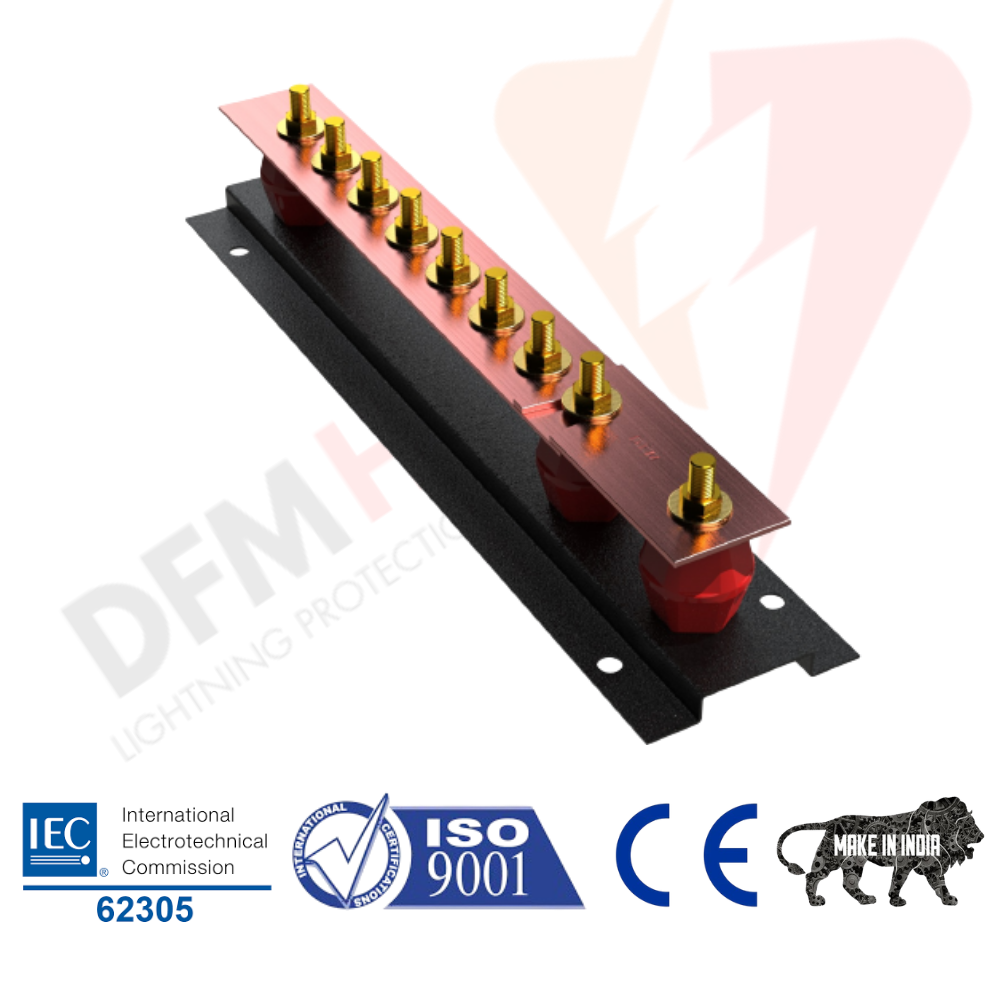
Equipotential Bonding Bar ARK Make by DFMHUB for Structural Lightning Protection Systems
Lightning protection is not only about intercepting lightning strikes and safely conducting current to earth—it is equally about controlling potential differences within a structure during transient events. The Equipotential Bonding Bar (EBB) plays a foundational role in this process by ensuring that all conductive parts of a building are bonded to a single reference potential, dramatically reducing the risk of flashover, side-flash, equipment damage, and human injury.
The Equipotential Bonding Bar – ARK Make by DFMHUB is engineered specifically for structural lightning protection systems used in Indian conditions, combining robust electrical performance, mechanical durability, and strict compliance with IEC 62305 and related international standards.
Designed for use in commercial buildings, industrial plants, data centers, hospitals, substations, infrastructure projects, and high-rise structures across India, the ARK Make Equipotential Bonding Bar ensures safe, measurable, and auditable bonding performance over the entire life of the installation.
What Is an Equipotential Bonding Bar?
Clear Technical Definition
An Equipotential Bonding Bar (EBB) is a metallic busbar—typically copper or tinned copper—used to interconnect:
Lightning down conductors
Earthing conductors
Structural steel reinforcements (rebars)
Electrical earths
Metallic services (water, gas, HVAC, cable trays)
The objective is to equalize electrical potential during lightning strikes or fault conditions so that no dangerous voltage difference can develop between conductive elements.
Why It Matters in Lightning Events
During a lightning discharge:
Current magnitude can exceed 200 kA
Voltage gradients rise sharply across structures
Unbonded metallic parts can create side flashes
An equipotential bonding bar eliminates these risks by creating a low-impedance common bonding point.
Equipotential Bonding Bar ARK Make by DFMHUB – Product Overview
Core Design Philosophy
The ARK Make Equipotential Bonding Bar is designed with a system-level engineering approach, ensuring:
Minimal contact resistance
High mechanical integrity
Long-term corrosion resistance
Easy inspection and testing
Key Engineering Objectives
Support high lightning impulse currents
Maintain performance under Indian climatic stress
Allow multiple conductor terminations without compromise
Enable structured, auditable lightning protection layouts
Component-Wise Construction Breakdown
| Component | Specification | Engineering Purpose |
|---|---|---|
| Main Bar Material | High-conductivity electrolytic copper / tinned copper | Low impedance current flow |
| Surface Treatment | Electro-tinned or bare copper | Corrosion resistance |
| Terminal Holes | Precision drilled / slotted | Secure conductor termination |
| Fasteners | Stainless steel / brass | Long service life |
| Insulating Mount | FRP / UV-stabilized polymer | Electrical isolation |
| Mounting Base | Wall or panel mount | Structural stability |
| Identification | Engraved / labeled | Maintenance clarity |
Electrical & Mechanical Performance Parameters
| Parameter | Value / Range |
|---|---|
| Copper Purity | ≥ 99.9% |
| Current Carrying Capacity | Designed for lightning impulse currents |
| Contact Resistance | Extremely low (< micro-ohm range) |
| Mechanical Strength | Suitable for industrial environments |
| Operating Temperature | -10°C to +60°C |
| Expected Service Life | 25+ years |
Design & Engineering Methodology (Step-by-Step)
Step 1: Risk Assessment (IEC 62305-2)
Lightning risk evaluation for structure
Identification of bonding points
Step 2: Bonding Network Design
Down conductor interconnection
Earthing grid interface
Equipment earth integration
Step 3: Bonding Bar Placement
Main Equipotential Bonding Bar (MEBB)
Local Equipotential Bonding Bars (LEBBs)
Accessibility for inspection
Step 4: Conductor Termination
Use of approved lugs/clamps
Controlled torque tightening
Step 5: Verification & Documentation
Continuity testing
Visual inspection
As-built drawings
Compliance with Standards & Regulations
Standards & Compliance Table
| Standard | Description | Compliance |
|---|---|---|
| IEC 62305 | Lightning Protection | ✔ Fully Compliant |
| IEC 62561 | LPS Components | ✔ Compliant |
| IS/IEC 60099 | Surge Protection | ✔ System Compatible |
| NBC India | Building Safety | ✔ Aligned |
| CPWD / PWD Specs | Govt. Projects | ✔ Accepted |
India-Specific Engineering Considerations
Soil Conditions
High resistivity soils (rocky, sandy)
Seasonal moisture variation
Chemical aggressiveness in coastal regions
Climate Factors
Extreme heat cycles
High humidity & monsoons
Industrial pollution exposure
How ARK Make Addresses This
Corrosion-resistant finishes
Robust mechanical mounts
Long-term conductivity stability
Industry-Wise Applications
Commercial Buildings
IT parks
Corporate offices
High-rise towers
Industrial Facilities
Manufacturing plants
Refineries
Warehouses
Infrastructure
Airports
Metro rail projects
Tunnels & bridges
Critical Facilities
Hospitals
Data centers
Power substations
Indian City Use Cases
Coastal: Mumbai, Chennai, Kochi
High-rise: Bengaluru, Gurugram
Industrial: Pune, Ahmedabad, Vadodara
Manufacturer vs Trader: Why It Matters
| Aspect | Manufacturer (DFMHUB) | Trader |
|---|---|---|
| Design Control | ✔ Full | ✖ None |
| Customization | ✔ Project-specific | ✖ Limited |
| Traceability | ✔ Material & batch | ✖ Unknown |
| Compliance | ✔ Documented | ✖ Unverified |
| Technical Support | ✔ Engineering-backed | ✖ Sales-only |
| Long-Term Reliability | ✔ Proven | ✖ Uncertain |
Testing, Quality Control & Certifications
Manufacturing QA
Raw material inspection
Dimensional verification
Surface finish checks
Electrical Testing
Continuity testing
Resistance measurement
Mechanical Testing
Fastener torque validation
Mount integrity checks
Documentation
Test reports
Compliance certificates
Installation guidelines
Services & Technical Support
Lightning protection design assistance
BOQ & tender support
Site installation guidance
As-built documentation
Post-installation audit support
Frequently Asked Questions (FAQs)
1. What is the role of an equipotential bonding bar in lightning protection?
It equalizes potential between conductive parts, preventing dangerous voltage differences during lightning events.
2. Is the ARK Make bonding bar compliant with IEC 62305?
Yes, it is fully designed to align with IEC 62305 lightning protection requirements.
3. Can it be used in coastal Indian environments?
Yes, corrosion-resistant materials make it suitable for coastal and industrial regions.
4. How many conductors can be terminated?
Customization allows multiple termination points as per project needs.
5. Is it suitable for data centers?
Absolutely—equipotential bonding is critical for sensitive electronic environments.
6. Can it be used for both lightning and electrical earthing?
Yes, when designed correctly as part of an integrated earthing system.
7. Does DFMHUB provide customization?
Yes, bonding bars can be tailored for size, hole pattern, and mounting.
8. What maintenance is required?
Periodic visual inspection and continuity testing.
9. Is it approved for government projects?
Yes, compliant with commonly referenced Indian and international standards.