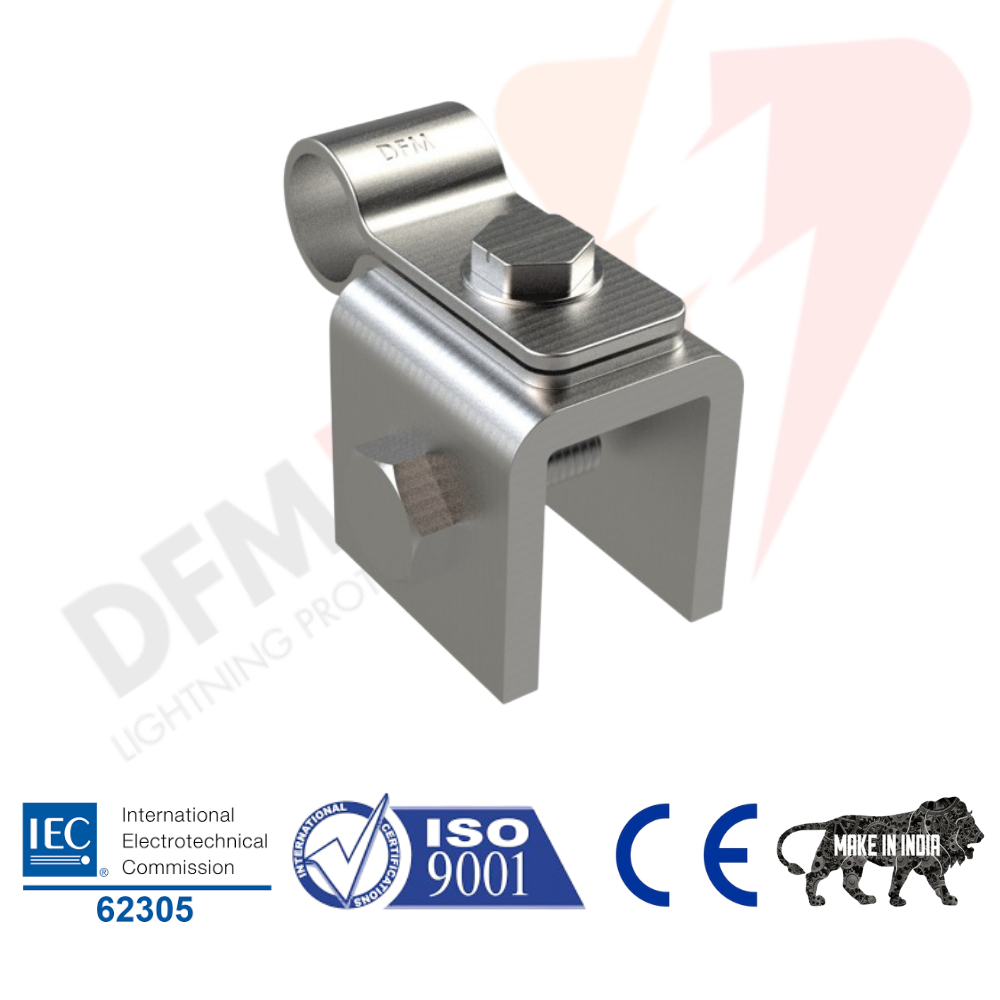
Roof Conductor Holder Clamp ARK Make | Lightning Protection Accessories by DFMHUB India
Why Roof Conductor Holder Clamps Matter in Lightning Protection
A Roof Conductor Holder Clamp is a critical mechanical and electrical interface in any lightning protection system (LPS). While air terminals and down conductors receive most design attention, failure at the conductor fixing point is one of the most common causes of lightning system malfunction in Indian installations.
The Roof Conductor Holder Clamp – ARK Make by DFMHUB is engineered to securely hold lightning conductors on rooftops while maintaining:
Correct conductor spacing
Mechanical stability under wind uplift
Long-term corrosion resistance
Electrical continuity as per IEC 62305
Designed and manufactured specifically for Indian climatic, structural, and regulatory conditions, ARK roof conductor holder clamps are used across industrial plants, commercial buildings, solar rooftops, data centers, oil & gas facilities, and infrastructure projects.
This page provides a technical, engineering-led, decision-maker-focused breakdown of the product — suitable for EPC contractors, consultants, MEP engineers, and safety auditors.
What Is a Roof Conductor Holder Clamp?
A Roof Conductor Holder Clamp is a mechanical fixing accessory used to:
Secure lightning protection conductors (copper, aluminum, GI)
Maintain defined separation from the roof surface
Prevent conductor displacement due to wind, thermal expansion, or vibration
It acts as the interface between the roof substrate and the lightning conductor network, ensuring that the designed lightning path remains intact throughout the system’s lifecycle.
Why ARK Make Roof Conductor Holder Clamp by DFMHUB Is Different
DFMHUB designs ARK lightning protection accessories with a manufacturer-first engineering approach, not as generic trading items.
Design Philosophy
Built for high-wind zones (coastal & cyclone-prone India)
Resistant to UV radiation, acid rain, industrial pollution
Compatible with flat RCC roofs, metal sheets, and solar mounting structures
Engineered for long service life with minimal maintenance
Product Overview: ARK Roof Conductor Holder Clamp
| Parameter | Specification |
|---|---|
| Product Name | Roof Conductor Holder Clamp |
| Brand | ARK Make |
| Manufacturer | DFMHUB |
| Application | Lightning Protection System (LPS) |
| Compatible Conductors | Copper, Aluminum, GI |
| Conductor Diameter Range | 8 mm – 25 mm (customizable) |
| Mounting Type | Surface-mounted / structure-mounted |
| Finish Options | Hot Dip Galvanized / Copper Bonded / SS |
| Compliance | IEC 62305 |
| Manufacturing | Made in India |
Design & Engineering Methodology
DFMHUB follows a step-by-step engineering methodology for ARK roof conductor holder clamps:
Step 1: Load Analysis
Wind uplift forces (as per Indian coastal zones)
Conductor self-weight and thermal expansion
Step 2: Material Selection
Base metal selected for mechanical strength
Coating thickness optimized for corrosion life cycle
Step 3: Electrical Continuity Validation
Contact resistance minimized
No arcing or sparking under impulse currents
Step 4: Environmental Durability
UV exposure testing
Moisture and salt spray resistance
Indian Conditions: Why Generic Imported Clamps Fail
Many imported clamps are designed for European conditions and fail prematurely in India due to:
| Indian Condition | Impact on Poor-Quality Clamps |
|---|---|
| High humidity | Rapid corrosion |
| Coastal salinity | Coating failure |
| Extreme heat | Material fatigue |
| Industrial pollution | Surface degradation |
| Monsoon winds | Mechanical loosening |
ARK Make clamps are engineered and tested with these Indian realities in mind.
Testing & Quality Assurance
Every batch of ARK roof conductor holder clamps undergoes:
Dimensional accuracy checks
Mechanical load testing
Coating thickness measurement
Visual and surface defect inspection
Optional Project-Specific Testing
Salt spray test (for coastal projects)
Pull-out and vibration tests
Standards & Compliance
| Standard | Description |
|---|---|
| IEC 62305 | Lightning Protection Systems |
| ISO Manufacturing Practices | Quality-controlled production |
| Indian Project Specs | PSU, EPC, and consultant requirements |
Industry-Wise Applications
Industrial Facilities
Manufacturing plants
Chemical and pharmaceutical units
Commercial Buildings
IT parks
Hospitals
Airports
Renewable Energy
Rooftop solar plants
Utility-scale solar structures
Infrastructure
Metro stations
Data centers
Oil & gas terminals
Manufacturer vs Trader: Why It Matters
| Aspect | DFMHUB (Manufacturer) | Typical Trader |
|---|---|---|
| Design control | Yes | No |
| Customization | High | Limited |
| Traceability | Full | None |
| Standards compliance | Documented | Claimed |
| Technical support | Engineering-led | Sales-led |
Choosing DFMHUB ARK Make ensures engineering accountability, not just supply.
Installation Best Practices (Consultant-Friendly)
Maintain specified clamp spacing
Avoid over-tightening (prevents conductor damage)
Ensure direct metal-to-metal contact
Verify continuity during system testing
Services & Support by DFMHUB
Pre-bid technical support
BOQ optimization assistance
Installation guidance
Documentation & compliance support
Frequently Asked Questions (FAQs)
1. Is the ARK roof conductor holder clamp IEC 62305 compliant?
Yes. It is designed to meet IEC 62305 requirements for lightning protection accessories.
2. Can it be used for solar rooftop installations?
Yes. It is compatible with solar mounting structures and rooftop solar plants.
3. What conductor sizes are supported?
Standard sizes from 8 mm to 25 mm. Custom sizes available.
4. Is it suitable for coastal areas like Chennai or Mumbai?
Yes. HDG and copper-bonded versions are ideal for coastal environments.
5. Does it damage waterproofing membranes?
No. Optional insulating spacers prevent membrane damage.
6. Can DFMHUB provide project documentation?
Yes. Datasheets, compliance documents, and test reports are available.
7. Is customization possible for EPC projects?
Yes. DFMHUB supports project-specific designs.
8. What is the expected service life?
Typically 20+ years, depending on environment and coating.