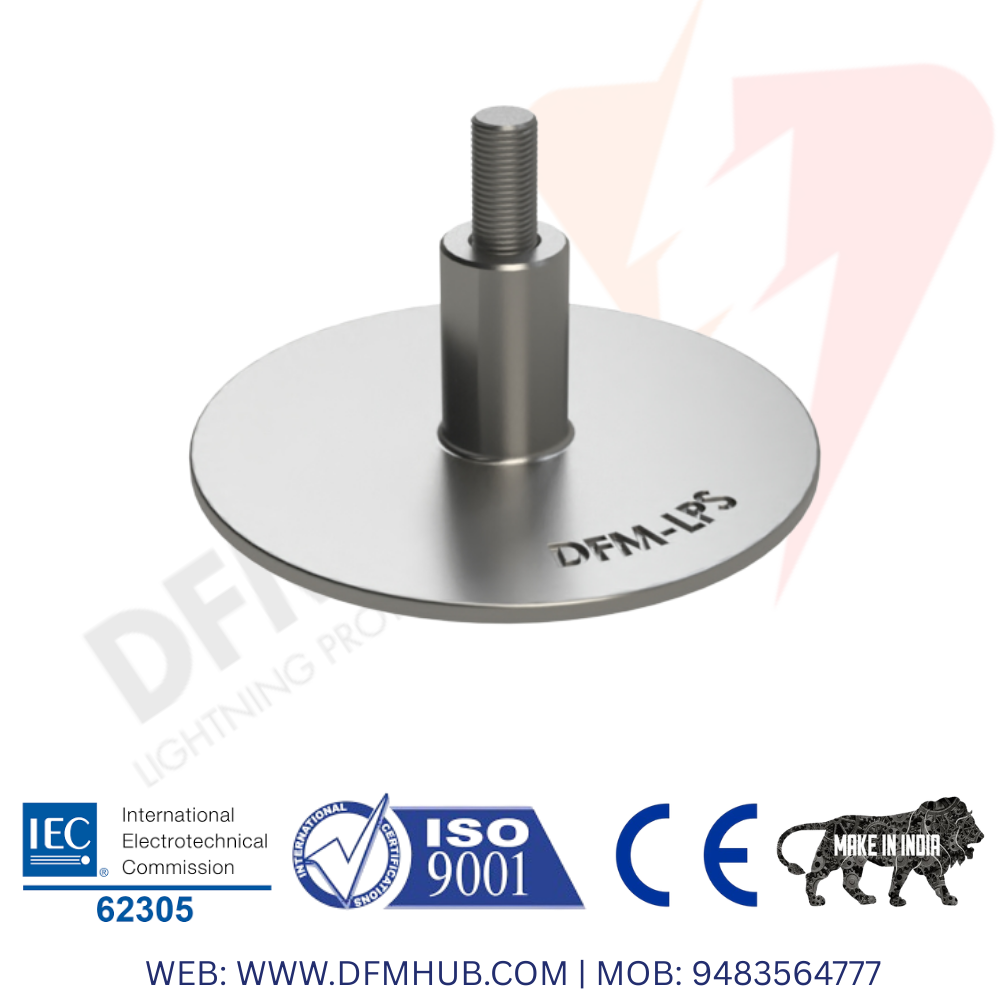
Strike Pad ARK Make by DFMHUB Used in Structural Lightning Protection System
A Strike Pad is a critical protective component installed at the base of lightning down conductors or at high-risk impact zones of a structure. Its primary role is to absorb, distribute, and safely dissipate lightning strike energy, preventing direct damage to masonry, concrete, waterproofing layers, and architectural finishes.
The Strike Pad ARK Make by DFMHUB is specifically engineered for structural lightning protection systems used across India, where high lightning density, variable soil resistivity, monsoon-driven moisture ingress, and diverse construction practices demand robust, code-compliant solutions.
This page provides an engineering-led, standards-focused explanation of Strike Pads — covering design methodology, materials, testing, Indian use cases, and compliance — written for consultants, EPC contractors, electrical engineers, and infrastructure decision-makers.
Why Strike Pads Are Essential in Indian Lightning Protection Designs
India records one of the highest lightning strike densities globally, particularly in regions such as:
Maharashtra (Mumbai, Pune, Nagpur)
Telangana & Andhra Pradesh
Odisha & West Bengal
Karnataka & Kerala
NCR (Delhi, Noida, Gurugram)
In these conditions, lightning energy traveling through a down conductor can:
Cause concrete spalling
Crack masonry and plinth protection
Damage waterproofing membranes
Create dangerous step and touch potentials near ground level
A properly designed Strike Pad mitigates these risks by acting as a mechanical and thermal buffer at the most vulnerable interface between conductor and structure.
Designed & Manufactured for Indian Conditions
Strike Pad ARK Make by DFMHUB is not a generic imported accessory. It is designed, engineered, and manufactured in India, considering:
High ambient temperatures (45–50°C surface exposure)
Heavy monsoon rainfall and water stagnation
UV exposure on external walls
Mixed construction materials (RCC, AAC blocks, stone cladding)
Variable earthing resistance across Indian soil types
This ensures long-term reliability and lifecycle safety, even in aggressive environments.
Component-Wise Breakdown of Strike Pad ARK Make
| Component | Material Specification | Engineering Function |
|---|---|---|
| Strike Plate Body | High-conductivity copper / copper alloy | Absorbs and spreads lightning impulse |
| Mounting Base | Heavy-duty insulating or metallic base | Prevents direct masonry impact |
| Conductor Interface | Compatible with flat/tape/round conductors | Ensures low-resistance continuity |
| Fasteners | SS / corrosion-resistant alloy | Long-term mechanical stability |
| Surface Finish | Natural copper / protective coating | Weather and corrosion resistance |
Engineering Design Methodology
Step-by-Step Functional Design Logic
Strike Interception Zone Identification
Installed at locations where lightning current density peaks — typically near ground termination points.Energy Dispersion Principle
The Strike Pad spreads the current over a larger surface area, reducing localized thermal stress.Mechanical Isolation
Prevents direct conductor-to-concrete contact during high impulse events.Continuity Assurance
Maintains uninterrupted electrical path between down conductor and earthing system.Durability Engineering
Designed to survive repeated surge events without deformation or loosening.
Electrical Performance Characteristics
| Parameter | Typical Value |
|---|---|
| Peak Lightning Current Handling | As per IEC 62305 (up to 200 kA) |
| Impulse Withstand | High impulse current tolerance |
| Contact Resistance | Extremely low |
| Thermal Stability | Maintains integrity during surge heating |
| Mechanical Load | Suitable for exposed installations |
Compliance with International & Indian Standards
Standards & Compliance Table
| Standard | Description | Compliance |
|---|---|---|
| IEC 62305 | Protection against lightning | ✔ Fully compliant |
| IEC 62561 | Lightning protection system components | ✔ Applicable |
| IS/IEC 62305 | Indian adoption of IEC | ✔ Followed |
| NBC India | Structural safety guidelines | ✔ Compatible |
Typical Installation Locations
Base of down conductors at plinth level
External façade near ground termination
Industrial structures with exposed conductors
Rooftop-to-wall transition zones
High-rise building periphery
Installation Methodology (Consultant-Friendly)
Verify down conductor routing and earthing layout
Fix Strike Pad securely on prepared surface
Ensure firm mechanical anchoring
Connect down conductor with approved clamps
Verify electrical continuity
Record installation as part of LPS documentation
Industry-Wise Applications in India
Commercial Buildings
IT Parks in Bengaluru & Hyderabad
Corporate offices in Mumbai & NCR
Infrastructure & Utilities
Airports, metro stations, rail terminals
Power substations and control rooms
Industrial Facilities
Refineries, chemical plants, manufacturing units
Warehouses and logistics hubs
Residential & High-Rise
Luxury towers and gated communities
Hospitals and educational campuses
Manufacturer vs Trader: Why It Matters
| Aspect | DFMHUB (Manufacturer) | Generic Trader |
|---|---|---|
| Design Control | ✔ In-house engineering | ✖ None |
| Material Traceability | ✔ Yes | ✖ Limited |
| Customization | ✔ Project-specific | ✖ Standard only |
| Compliance Support | ✔ Full documentation | ✖ Not available |
| Long-Term Support | ✔ Yes | ✖ Transactional |
Testing, Quality Control & Documentation
Each Strike Pad ARK Make by DFMHUB undergoes:
Material verification
Dimensional accuracy checks
Mechanical strength testing
Visual and finish inspection
Documentation Provided:
Product datasheet
Compliance declaration
Installation guidelines
Test reports (on request)
Services & Technical Support
Lightning risk assessment support
BOQ & tender assistance
Consultant submittals
Site installation guidance
After-sales technical support
📞 Request a technical consultation with DFMHUB engineers
Frequently Asked Questions (FAQs)
1. What is the main function of a strike pad?
To absorb and distribute lightning current safely, preventing structural damage.
2. Is a strike pad mandatory under IEC 62305?
It is recommended wherever down conductors interface with structures.
3. Can it be used with copper bonded or GI conductors?
Yes, ARK Make Strike Pads are compatible with standard conductors.
4. Is it suitable for coastal or high-corrosion areas?
Yes, material options are available for aggressive environments.
5. Where is it installed in a building?
Typically at the base of down conductors near ground level.
6. Does it reduce step and touch potential?
Yes, by controlling current dispersion.
7. Is it custom-manufacturable?
Yes, sizes and configurations can be customized.
8. Is documentation provided for consultants?
Complete technical and compliance documentation is available.
9. Is it suitable for retrofitting?
Yes, it can be installed in existing LPS systems