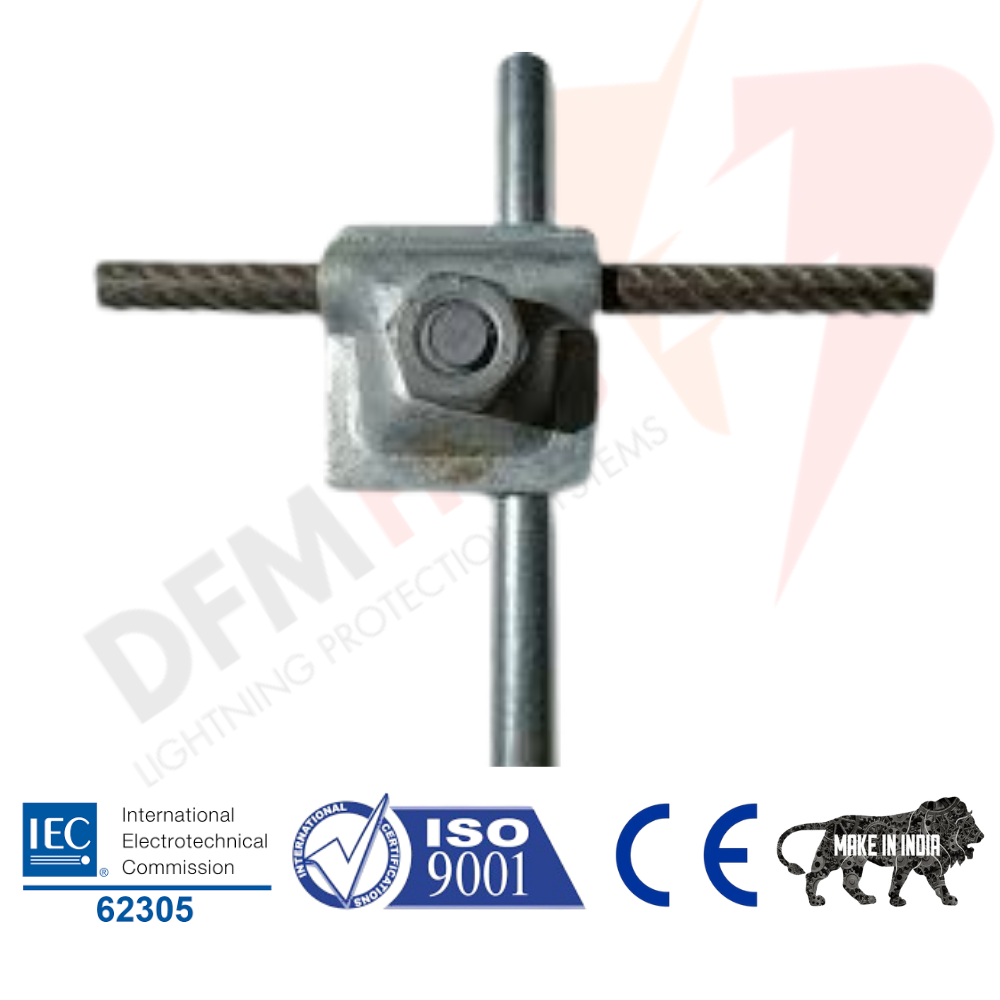
Test Joint – ARK Make by DFMHUB | Lightning Protection Component for India
Test Joint ARK Make by DFMHUB is a precision-engineered earthing and lightning protection system (LPS) component designed to enable safe isolation, inspection, and testing of down conductors and earth electrodes. Engineered for Indian soil conditions, tropical climate, and regulatory frameworks, this test joint delivers mechanical integrity, electrical continuity, corrosion resistance, and long-term reliability—without compromise.
Within lightning protection architectures, the test joint is the critical inspection interface. It allows periodic resistance measurement, visual inspection, and maintenance—ensuring the system continues to meet performance benchmarks throughout its service life. ARK Make by DFMHUB integrates robust metallurgy, precision machining, and field-proven testing to serve EPCs, consultants, utilities, and industrial asset owners across India.
What Is a Test Joint?
A test joint (also known as a test link or inspection joint) is a removable conductive link installed between the down conductor and the earth electrode. It allows:
Electrical isolation of the earthing electrode,
Accurate measurement of earth resistance,
Routine inspection and maintenance without dismantling the system.
In lightning protection systems, test joints are mandatory for compliance with inspection regimes prescribed by IEC 62305 and best engineering practices.
Why Test Joint Performance Matters in Indian Conditions
India presents high variability in soil resistivity (laterite, clay, black cotton soil, sand), high humidity, coastal salinity, industrial pollutants, and extreme temperature cycles. A poorly designed test joint can cause:
Increased contact resistance,
Galvanic corrosion,
Mechanical loosening due to vibration or thermal cycling,
False earth resistance readings.
ARK Make by DFMHUB is designed and manufactured for India, addressing these exact challenges through materials, testing, and process control.
Design Philosophy: ARK Make by DFMHUB
Engineering Objectives
Low contact resistance across service life
High mechanical clamping force without conductor damage
Corrosion resistance in aggressive environments
Repeatable disconnection & reconnection for testing
Compliance with IEC 62305 inspection requirements
Methodology (Step-by-Step)
Material Selection based on conductivity, corrosion resistance, and mechanical strength
Precision Machining for flatness and mating surfaces
Surface Treatment to mitigate oxidation and salt attack
Mechanical Locking Design to prevent loosening
Electrical & Environmental Testing under simulated field conditions
Electrical & Mechanical Performance Testing
1. Lightning Impulse Current Test
Simulates high-energy lightning surge currents
Ensures no melting, deformation, or contact degradation
Confirms suitability for LPS down conductor paths
2. Salt Spray Analysis
Conducted as per ASTM B117 equivalent
Validates corrosion resistance for:
Coastal India (Mumbai, Chennai, Kochi)
Industrial zones (chemical plants, refineries)
3. Electrical Resistivity & Contact Resistance
Measures micro-ohmic continuity
Ensures stable readings before & after disconnection cycles
4. Loosening Torque Test
Verifies bolt retention under vibration
Prevents false resistance readings due to mechanical slack
Standards & Compliance
| Standard / Guideline | Compliance Status | Relevance |
|---|---|---|
| IEC 62305 | Compliant | Lightning Protection Systems |
| IS / IEC Earthing Practices | Aligned | Indian installations |
| ASTM B117 (Salt Spray) | Tested | Corrosion resistance |
| Internal QA Protocols | 100% batch-tested | Consistency & traceability |
Applications Across Industries
| Industry | Application Use |
|---|---|
| Power & Utilities | Substations, transmission towers |
| Renewable Energy | Solar PV plants, wind farms |
| Oil & Gas | Refineries, tank farms |
| Data Centers | Critical grounding & bonding |
| Infrastructure | Airports, metros, railways |
| Commercial Buildings | High-rise LPS inspection |
| Manufacturing | Heavy machinery grounding |
India-Specific Use Cases
High-resistivity soil regions (Rajasthan, Gujarat): Enables accurate electrode testing
Coastal regions (Tamil Nadu, Maharashtra): Salt-resistant metallurgy
High rainfall zones (Kerala, Northeast): Moisture-tolerant connections
Industrial belts (Pune, Ahmedabad, Chennai): Pollution-resistant performance
Manufacturer vs Trader: Why It Matters
| Parameter | DFMHUB (Manufacturer) | Typical Trader |
|---|---|---|
| Design Ownership | ✔ In-house engineering | ✖ Off-the-shelf |
| Material Traceability | ✔ Certified batches | ✖ Unknown |
| Testing Capability | ✔ Electrical & mechanical | ✖ Visual only |
| Customization | ✔ Yes | ✖ Limited |
| Technical Support | ✔ Engineering-led | ✖ Sales-led |
| Long-Term Reliability | ✔ Proven | ✖ Inconsistent |
Choosing a manufacturer ensures performance accountability—not just supply.
Services & Technical Support
Pre-bid technical consultation
BOQ & drawing support
Site-specific material selection
Installation & inspection guidance
Documentation for audits & safety reviews
Frequently Asked Questions (FAQ)
1. Why is a test joint mandatory in lightning protection systems?
It enables periodic isolation and testing of the earth electrode without dismantling the system, as recommended by IEC 62305.
2. Where should the test joint be installed?
Typically at a reachable height on the down conductor, just above ground level.
3. Is ARK Make test joint suitable for coastal environments?
Yes. It is salt-spray tested and designed for high-humidity, saline conditions.
4. Can it be used with copper and GI conductors?
Yes, compatibility options are available based on conductor material.
5. Does loosening occur over time?
No. Loosening torque tests validate long-term mechanical stability.
6. How often should testing be done?
As per IEC 62305 and site risk assessment—usually annually or after major lightning events.
7. Is customization available?
Yes. Size, material, and enclosure customization can be engineered.
8. Does DFMHUB provide installation guidance?
Yes. Engineering-led support and documentation are provided.
9. How does this differ from low-cost test links?
Low-cost links lack testing, material control, and torque stability—leading to unreliable readings.